These three services share a category name but solve different problems:
Mailtrap optimizes for deliverability infrastructure and pre-production testing.
Resend optimizes for developer experience and language coverage.
AgentMail is built around the premise that agents need inboxes, not just a send endpoint.
Which email API for AI agents fits your stack depends on what your agent actually does with email.
- Mailtrap: Best for production agentic workflows with strong deliverability requirements, MCP-native setup, and teams that test email before production. Skip it if you need conversation threading, webhook or WebSocket real-time events, or built-in draft review for multi-turn agent conversations.
- Resend: Best for outbound-only agents, TypeScript-first stacks, and the broadest language coverage. Skip it if you need more than a webhook for inbound, or you need SOC 3, ISO 27001, or vertical-specific certifications.
- AgentMail: Best for agents that own inboxes, read replies, and maintain conversations; multi-tenant deployments via Pods; human-in-the-loop review workflows. Skip it if you only need outbound at scale.
What each service is actually built for
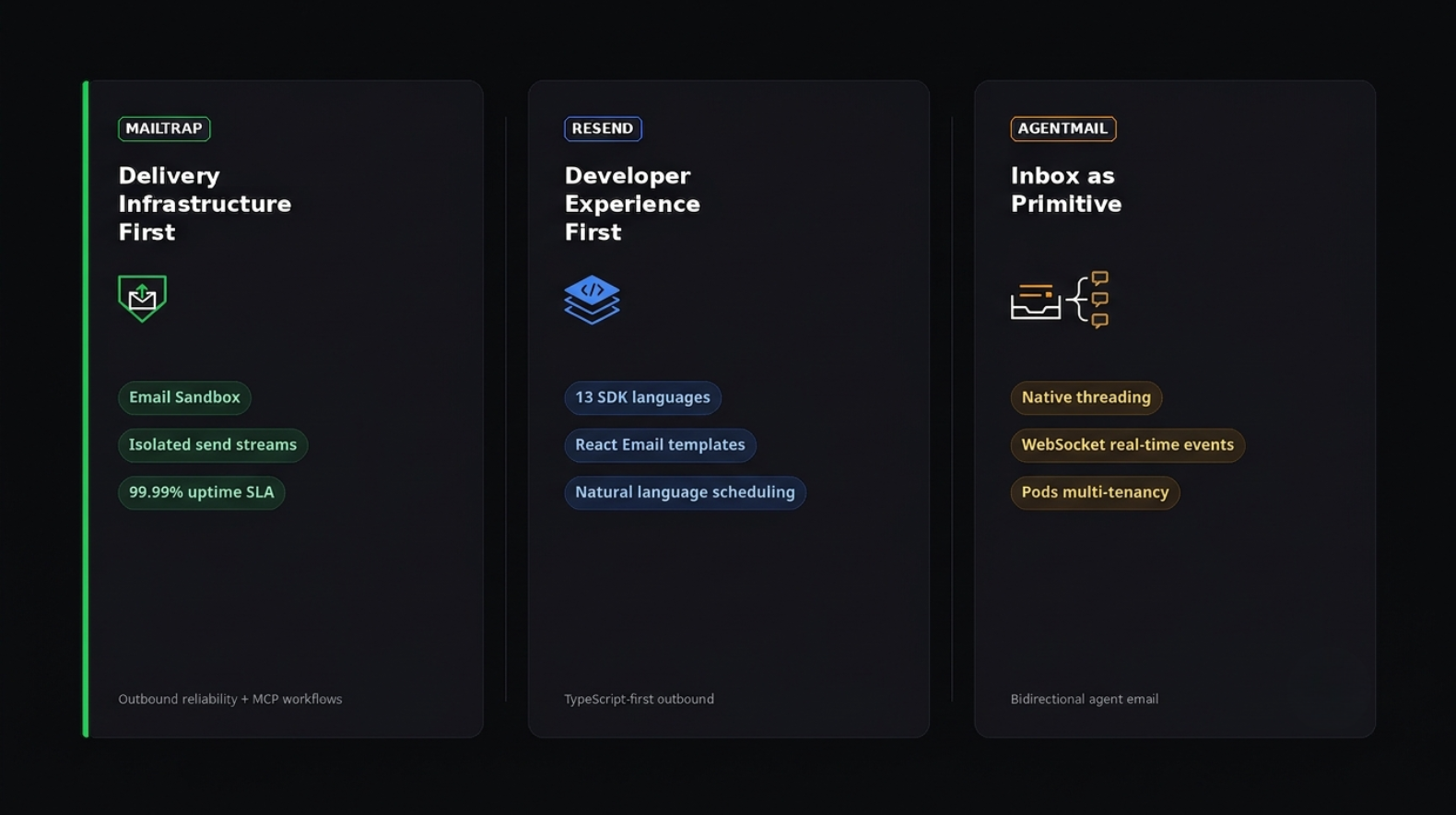
Mailtrap started as an email testing sandbox and expanded into a full delivery platform. That history shapes the entire product: the Email API and Email Sandbox are sold as separate products, transactional and bulk sending run on dedicated isolated streams so reputation problems in one cannot bleed into the other.
Also, the MCP server is the only one among these three that gives an AI agent direct sandbox access. An agent can verify its own emails render correctly before they reach a real inbox. The reported inbox placement rate of 78.8% (Mailtrap's own benchmark) reflects infrastructure that has been tuned for deliverability since the company started, with a 99.99% uptime SLA.
Resend launched with a clean REST API, React Email integration, and a TypeScript-first SDK. It treats language support as a first-class feature: 13 official language clients versus the two or three that most providers manage.
The product is opinionated: it knows what it does well (outbound delivery with strong developer experience) and stays focused there. Inbound email arrived in November 2025 via webhook, which means agents can parse incoming messages but are responsible for their own storage, threading, and state management. Scheduling is flexible: sends can be triggered with natural language time expressions or ISO 8601 timestamps.
AgentMail is the newest of the three (YC S25, $6M seed led by General Catalyst) and the only one purpose-built for AI agent workflows. It was designed around a specific question: what if the inbox, not the send endpoint, were the primitive?
Agents get programmatic inboxes via API, send and receive through the same SDK, and thread conversations automatically. New messages reach the agent in real time through webhooks or WebSocket, whichever fits the architecture. Every agent gets its own inbox and address, while paid plans support verified custom domains. For platforms provisioning email across many agents or customers, Pods provide isolated multi-tenant containers, each with its own inboxes and domains. AISDR runs 500 production inboxes on the platform.
How each service handles outbound email
At the outbound level, all three work. Here are minimal Python examples for each: same intent, different architecture.
Mailtrap:
import mailtrap as mt

client = mt.MailtrapClient(token="YOUR_API_TOKEN")
mail = mt.Mail(
    sender=mt.Address(email="agent@yourdomain.com", name="My Agent"),
    to=[mt.Address(email="user@example.com")],
    subject="Your order is confirmed",
    text="Order #1234 has been placed successfully.",
)
client.send(mail)
Resend:
import resend

resend.api_key = "re_your_api_key"
params = resend.Emails.SendParams(
    from_="agent@yourdomain.com",
    to=["user@example.com"],
    subject="Your order is confirmed",
    text="Order #1234 has been placed successfully.",
)
resend.Emails.send(params)
AgentMail:
from agentmail import AgentMail
from agentmail.inboxes.types import CreateInboxRequest

client = AgentMail(api_key="your_api_key")

inbox = client.inboxes.create(
    request=CreateInboxRequest(client_id="order-agent-v1")
)

client.inboxes.messages.send(
    inbox_id=inbox.email,
    to=["user@example.com"],
    subject="Your order is confirmed",
    text="Order #1234 has been placed successfully.",
)
Mailtrap and Resend patterns are conventional: initialize a client, build a message, send. AgentMail requires one extra step because the inbox is the primitive, not the send call. That step is what makes reply threading, multi-tenant isolation, and agent-specific reputation possible. Mailtrap and Resend skip it because they cannot support those things.
All three use API key authentication. Resend tokens use the re_ prefix; Mailtrap uses a plain token string; AgentMail uses a standard API key.
| Mailtrap | Resend | AgentMail | |
|---|---|---|---|
| API base URL | send.api.mailtrap.io/api/send | api.resend.com/emails | api.agentmail.to |
| Batch support | Up to 500 messages per call | Yes | Via Messages API |
| Published rate limit | 150 req / 10 seconds | Not published | Not published |
| Scheduled sending | No | Yes (natural language or ISO 8601) | Via Drafts |
| Idempotency support | Yes | Yes (Idempotency-Key header) | Yes (client_id on inbox creation) |
How each service handles inbound email
This is the most consequential architectural difference for agent builders and will likely determine your choice faster than anything else in this comparison.
AgentMail treats inbound email as a first-class concern. Every inbox you create can receive messages. Replies thread automatically. Agents can list, search, and read messages through the same SDK they use to send. New messages are delivered in real time two ways: webhooks push signed events (message.received and other event types) to a server endpoint, and WebSocket streams events over a persistent connection for agents that hold one open. Either path eliminates polling. The extracted_text field strips quoted history from replies so agents see only the new content, not the entire thread pasted below every response. Drafts let a human review a proposed reply before it goes out.
# List incoming messages, then fetch each one for its body content
listed = client.inboxes.messages.list(inbox_id=inbox.email)

for item in listed.messages:
    msg = client.inboxes.messages.get(
        inbox_id=inbox.email,
        message_id=item.message_id,
    )
    agent_sees = msg.extracted_text or msg.text
    print(msg.subject, agent_sees)

    # Reply in the same thread
    client.inboxes.messages.reply(
        inbox_id=inbox.email,
        message_id=msg.message_id,
        to=["user@example.com"],
        text="Thanks, I have updated your order.",
    )
For teams building on top of AgentMail rather than just with it, Pods extend the inbox model to multi-tenancy. Each Pod is an isolated container with its own inboxes and domains, so a platform provisioning email for its customers' agents gets separation of identity, data, and deliverability reputation per tenant without running parallel accounts. If your product ships agents to your own customers, this is the difference between multi-tenancy as an architecture feature and multi-tenancy as something you build yourself on top of a flat inbox list.
Resend added inbound via webhook in November 2025. When a message arrives at a Resend domain, the platform fires a webhook and retains the email for up to 30 days. Threading, state management, search, and reply routing are on the developer. For agents that only need to parse a confirmation email or catch a one-off reply, that is workable. For agents maintaining ongoing conversations across days or weeks, it means building the inbox layer yourself on top of the webhook events.
Mailtrap Inbound Email lets you provision a dedicated @inbound.mailtrap.io address in a single API call and start receiving messages immediately, no mail server or DNS setup required. When a message arrives, Mailtrap posts a signed JSON payload to your webhook endpoint with sender, subject, headers, and attachment download links already parsed out. Polling the Messages API directly is also an option. The X-Mailtrap-Signature header lets you verify the source (HMAC-SHA256); failed deliveries retry with exponential backoff across up to 10 attempts over 24 hours.
import requests

headers = {"Authorization": "Bearer YOUR_API_TOKEN"}
base = "https://mailtrap.io/api/v2/inbound"

# List incoming messages
resp = requests.get(f"{base}/inboxes/{inbox_id}/messages", headers=headers)
for msg in resp.json()["messages"]:
    print(msg["subject"], msg["text"])

# Download an attachment via signed link
att = requests.get(
    f"{base}/messages/{message_id}/attachments/{attachment_id}",
    headers=headers
)
One detail that separates Mailtrap's inbound from both Resend and AgentMail: you can run your full inbound workflow against the Sandbox before pointing at a production address. If your agent auto-creates tickets, extracts order IDs, or routes messages by subject line, you can verify all of that logic works correctly before real messages arrive.
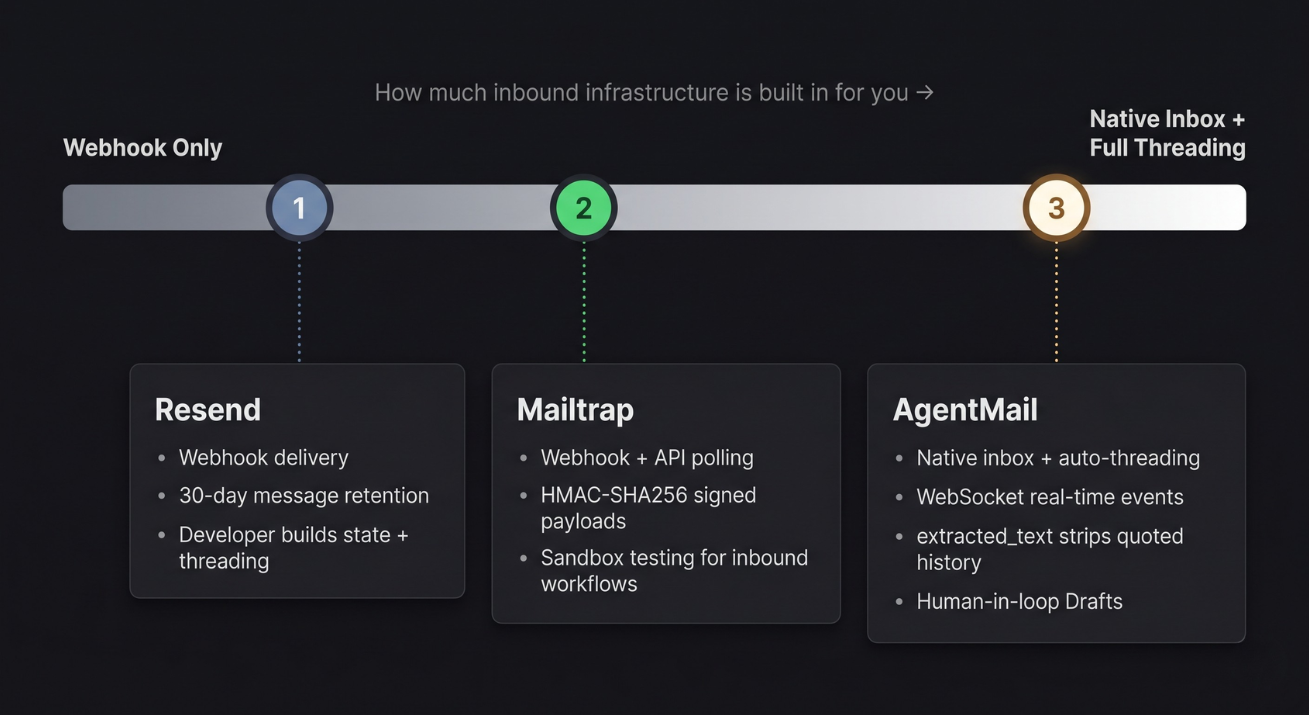
Conversation threading, real-time webhook and WebSocket events, and draft review before replies go out are not part of Mailtrap's inbound feature. Agents that need those capabilities built in should look at AgentMail.
MCP support and agent framework integrations
All three providers ship official MCP servers, which means an agent running in Claude Code, Cursor, Windsurf, or any other MCP-compatible environment can interact with email infrastructure through natural language without integration code.
Mailtrap's MCP server for AI agents provides 24 tools that cover the full Email API surface: sending transactional and bulk email, managing Handlebars templates, inspecting email logs, pulling delivery stats broken down by domain and mailbox provider, configuring sending domains, and, uniquely among these three, running Email Sandbox tests. An agent can prompt the MCP to send a test version, verify how it renders across clients, check spam scores, and confirm SPF/DKIM/DMARC pass before touching the production send endpoint.
Mailtrap also ships Skills: three reference files that give coding agents Mailtrap-specific context, including API endpoints, payload shapes, authentication patterns, and documented edge cases. The intent is that an agent writing a Mailtrap integration gets working code on the first attempt, without hallucinating parameter names. Compatible with Claude Code, Cursor, and any tool that supports the format.
Resend's MCP server covers a wider account management surface. Tools include: send, batch, list, get, cancel, and update emails; read inbound emails and download attachments; manage contacts, audiences, segments, and topic subscriptions; schedule and personalize broadcasts; add, verify, and remove domains; configure webhooks; and manage API keys. Full account control from a single MCP connection, compatible with Cursor, Claude Code, Codex, Devin, GitHub Copilot, and Windsurf. See the Resend documentation for setup details.
AgentMail ships tested connectors for LangChain, LlamaIndex, CrewAI, and LiveKit, alongside an MCP server and Skills for Claude Code, Cursor, and OpenClaw. If your agent runs on one of those frameworks, the email layer is a first-class integration rather than a raw HTTP client you wire yourself. AgentMail also supports agent-initiated signup: an agent can provision its own email capability autonomously via x402, without a human completing the signup flow first, which neither Mailtrap nor Resend supports. The stronger advantage over the other two providers in this area is not the MCP server, since all three have one; it is the framework connectors and the fact that the platform can be adopted by the agent itself.
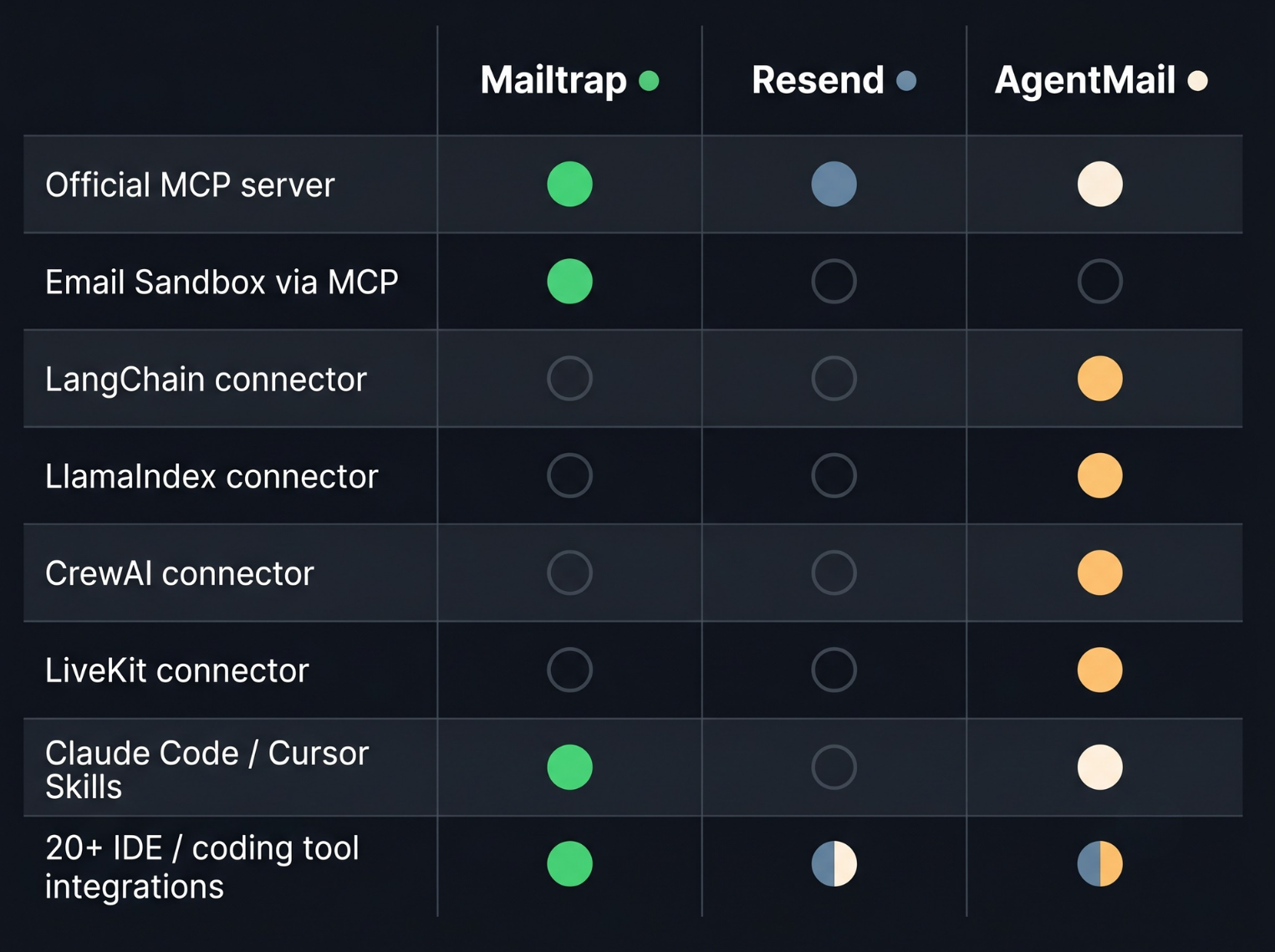
Note: Mailtrap connects with 20+ AI coding tools including Lovable, Bolt.new, V0, Replit, and Retool. These are development environments and coding assistants rather than agent orchestration frameworks, which is a different axis of integration. Resend's standard HTTP API works with any framework but ships no framework-specific connector packages.
Deliverability and inbox placement
Deliverability is where Mailtrap's infrastructure history is most visible.
Mailtrap separates transactional and bulk sending streams by default. A spike in marketing email bounces cannot hurt transactional delivery because they never share a reputation pool. Dedicated IPs are included from the Business tier ($85/month), with automatic warmup built in. Monthly DKIM key rotation runs without manual intervention. Blocklist monitoring fires alerts before delivery problems compound. The self-reported inbox placement rate is 78.8%, against a reported 61.0% for SendGrid and 71.4% for Mailgun in Mailtrap's own testing. Treat those figures as directional, not third-party verified.
The Email Sandbox is a pre-production testing environment: before a single email reaches a real inbox, an agent can send to the sandbox, inspect HTML rendering across email clients, check the spam score, and verify authentication headers, all via API or MCP prompt. Neither Resend nor AgentMail offer an equivalent. For teams where a rendering defect or a spam trap hit in production would be expensive to detect and fix, the sandbox changes the risk profile in a way the other two cannot match.
Resend's dedicated IP option ($30/month add-on on Scale plans) includes automatic warmup. For teams that need IP isolation, it is there; it just does not come standard the way it does in Mailtrap's higher tiers. Resend has no pre-send testing environment.
AgentMail supports custom domains with DKIM, SPF, and DMARC authentication, and dedicated IPs are available on custom plans. The platform is designed for agents operating at human-like volume from identifiable inboxes rather than bulk marketing sends, which changes what deliverability means: sender reputation is managed at the inbox and domain level, so a single misbehaving agent cannot burn the reputation of the whole fleet. IP isolation is available on custom plans when volume calls for it. For multi-tenant deployments, Pods extend that isolation one level up, keeping each tenant's deliverability reputation separate so one customer's sending behavior cannot affect another's.
Pricing at scale for AI agent workloads
The pricing models reflect the underlying architectural differences. Comparing them directly requires some translation because AgentMail prices inbox capacity alongside email volume, while Mailtrap and Resend price on volume alone.
| Mailtrap | Resend | AgentMail | |
|---|---|---|---|
| Free | 4,000 emails/mo (150/day limit) | 3,000 emails/mo (100/day limit) | 3 inboxes; 100/day; no separate 5-minute or monthly cap |
| Entry paid | $15/mo, 10k emails | $20/mo, 50k emails | $20/mo; 100/5 min, 1k/day, 10k/month; 10 inboxes |
| Mid-tier | $85/mo, 100k emails + dedicated IPs | $35/mo, 100k emails | $200/mo; 1.5k/5 min, 15k/day, 150k/month; 150 inboxes |
| High-volume | $450/mo, 750k emails | $90–$1,150/mo, 100k–2.5M | Custom |
| Dedicated IPs | Included at $85/mo | +$30/mo on Scale | Available on custom plans |
| Compliance | SOC 2 Type 2, SOC 3, ISO 27001, GDPR, CCPA (all tiers) | SOC 2 Type 2, GDPR, EU-US DPF | SOC 2 (Startup+ only, $200/mo) |
A few pricing realities worth noting.
Resend offers the strongest email-per-dollar ratio for pure outbound: 50,000 emails for $20/month is hard to beat if inbox management is not a requirement.
Mailtrap's $85/month Business tier bundles dedicated IPs that cost extra with Resend.
AgentMail's pricing bundles inbox capacity with email volume. At the Startup tier, 150 inboxes for $200/month works out to about $1.33 per inbox per month, reasonable if inboxes are active. For deployments where per-inbox pricing stops making sense, custom plans are available.
For any team that would otherwise build inbox provisioning, threading, and multi-tenant isolation on top of a flat send API, this cost is trivial against engineering time.
For the AISDR-scale deployment (500 inboxes), an AgentMail custom plan is the only option that provides inbox management out of the box.
The equivalent send volume through Mailtrap or Resend falls comfortably in the mid-tier range but requires building inbox management separately.
SDK quality and developer experience
Resend has the widest language coverage: 13 official clients across Node.js, Next.js, Express, PHP, Laravel, Python, Ruby, Rails, Go, Rust, Elixir, Java, .NET, and a CLI.
If your stack is unusual, Resend almost certainly has a client. React Email integration is native, which means building templates in JSX with component composition instead of managing Handlebars partials or raw HTML strings. The TypeScript-first design shows through the entire API surface.
Mailtrap maintains 7 official SDKs (Node.js, PHP, Python, Ruby, .NET, Java, Elixir) with a consistent API surface across all of them. The Handlebars template system supports conditionals and loops for dynamic content, relevant for agents assembling variable email content at runtime. Documentation covers step-by-step migration paths from SendGrid, Mailgun, SES, Postmark, Brevo, and Mailchimp.
AgentMail supports Python and TypeScript, the two languages where every major agent framework ships (LangChain, LlamaIndex, CrewAI, LiveKit, Vercel AI SDK). Language coverage matches where agents are built rather than where transactional email is sent. The SDK is clean, and the inbox abstraction is intuitive once you accept that inboxes are entities you create and manage rather than addresses you configure once and forget.
The client_id parameter on inbox creation enables idempotency, which is not a nice-to-have in agentic workflows but a requirement when network failures mean a tool might be called twice and a duplicate inbox would break downstream logic.
When Mailtrap is the right call
Your agents primarily send notifications, confirmations, alerts, or summaries to users, and landing those emails reliably is non-negotiable.
You want MCP-native workflows where an agent can test, configure, and monitor email from inside your development environment.
Pre-production sandbox testing is part of your team's quality bar.
You need broad SDK coverage across 7 languages and do not want to write raw HTTP clients.
Delivery analytics, per-domain stats, up to 30-day log retention, blocklist monitoring, is something your team actually uses rather than ignores.
What it does not cover: conversation threading, real-time webhook and WebSocket events on a native inbox, and human-in-the-loop draft review are not part of the inbound feature. For agents maintaining multi-turn conversations where those capabilities need to be built in rather than assembled from parts, AgentMail is the stronger fit.
When Resend is the right call
Your stack is TypeScript-first and React Email templating fits how your team thinks about component composition.
Your agents send outbound notifications and do not need to manage incoming email beyond parsing the occasional webhook payload.
You are optimizing for the highest email volume at the lowest per-email cost.
You need Go, Rust, or Rails SDK support, languages the other two do not officially cover.
Scheduling sends with natural language time expressions matters to your use case.
What it does not cover: agents that need persistent inbound state beyond 30-day webhook retention; any compliance requirement beyond SOC 2 and GDPR (SOC 3, ISO 27001, or vertical-specific certifications).
When AgentMail is the right call
Your agents need to read incoming email, not just send it.
You are building multi-agent systems where each agent operates from its own persistent inbox with a verifiable email identity.
Your workflow involves ongoing conversations: send, wait for reply, parse reply, act, send again.
You want real-time event delivery, via webhooks to a server endpoint or WebSocket streaming, instead of polling.
Your stack runs on LangChain, CrewAI, or LlamaIndex and you want tested connectors.
You are building a product where your customers' agents each need isolated, managed inboxes: the Pods architecture handles multi-tenant isolation of inboxes, domains, and sender reputation out of the box.
Your agents provision their own tooling: x402 agent signup means the agent itself can adopt the platform without a human in the loop.
What it does not cover: pure outbound at scale where inbox management adds cost without benefit; language stacks outside Python and TypeScript.
Summary comparison
| Mailtrap | Resend | AgentMail | |
|---|---|---|---|
| Primary use case | High-deliverability outbound + MCP tooling | Developer-first outbound | Bidirectional agent email |
| Inbound email | Webhook + poll; HMAC-signed; Sandbox testing for inbound workflows | Webhook-only (Nov 2025), 30-day retention | Native inbox, threading, webhooks, WebSocket, search |
| MCP server | Official + Skills (24 tools, sandbox access) | Official (full account control) | Official + Skills for Claude Code/Cursor |
| AI framework connectors | 20+ coding/dev tools | API-compatible (no specific connectors) | LangChain, CrewAI, LlamaIndex, LiveKit |
| Agent-initiated signup | No | No | Yes (x402) |
| Email sandbox | Yes (separate product, MCP accessible) | No | No |
| Official SDKs | 7 (Node, PHP, Python, Ruby, .NET, Java, Elixir) | 13 language clients | 2 (Python, TypeScript) |
| Dedicated IPs | Included from $85/mo | +$30/mo on Scale | Available on custom plans |
| Free tier | 4,000 emails/mo | 3,000 emails/mo | 3 inboxes; 100/day; no separate 5-minute or monthly cap |
| Compliance | SOC 2 Type 2, SOC 3, ISO 27001, GDPR, CCPA | SOC 2 Type 2, GDPR, EU-US DPF | SOC 2 (Startup+ tier only) |
| Human-in-loop drafts | No | No | Yes |
| Multi-tenant support | Separate sending streams | No inbox concept | Pods (isolated inboxes, domains, reputation per tenant) |
| Scheduling | No | Yes | Via Drafts |
Choosing the right email API for AI agents
The most direct answer: start with what your agent does when a user replies.
If it ignores the reply, because it only sends notifications, confirmations, or summaries and the conversation ends there, Mailtrap and Resend both serve that pattern well. Mailtrap is the stronger pick when deliverability visibility, sandbox testing, and MCP-native agentic workflows are part of your technical requirements. Resend is the stronger pick when language coverage, TypeScript-first developer experience, and outbound volume per dollar are the deciding factors.
If the reply is part of the workflow, meaning your agent needs to read it, reason over it, and respond, AgentMail is the only service in this comparison that was built to handle that without stitching together webhooks, storage, and threading logic yourself.
Most production agent systems will reach a point where outbound alone is not enough. Worth knowing which direction each tool scales before you commit.
AgentMail gives each agent a real inbox that can send, receive, thread, and reply through one API.

![AgentMail vs Resend for AI Agents [2026 Comparison]](/_next/image?url=%2Fblog%2Fagentmail-vs-resend.png&w=3840&q=75&dpl=dpl_82mXG9cDsEK1r2VryK3Z6KTWxvuy)