- The default for agent inboxes: AgentMail is the only API in this comparison built around the inbox as the primitive, giving each agent a real address, persistent message history, automatic threading, webhooks, WebSockets, and per-tenant isolation through Pods.
- Send-only agents: a transactional email API is enough when the agent only pushes notifications outward.
- Acting on a person's mailbox: Nylas Connected Accounts is the right tool when the agent works inside someone's existing Gmail or Outlook.
- Platform-bound cases: Cloudflare Email Service fits the Workers stack, and the Gmail API can work for a single Google Workspace tenant if you accept its operational cost.
- What this guide does: it groups the eight main options into four competing categories, contrasts them with AgentMail's category of one, and points to the right pick for each agent shape.
On this page
- The five categories of email options for AI agents
- The master comparison
- Category 1: Agent-native mailbox APIs
- Category 2: Transactional email APIs
- Category 3: Email integration APIs
- Category 4: Provider-native APIs
- Category 5: Edge platform email
- Decision tree: which one for which agent shape
- Which email API is best for receiving and parsing replies?
- Why AgentMail is the right default for agent inboxes
- Choosing your path
The five categories of email options for AI agents
The email infrastructure landscape for AI agents in 2026 splits cleanly into five categories. Each one solves a different problem.
- Agent-native mailbox APIs. Built around the inbox object: programmatic provisioning, persistent storage, automatic threading, scoped multi-tenancy. AgentMail is the only API in this category.
- Transactional email APIs. Built around outbound delivery: send notifications, password resets, broadcasts. Inbound is webhook-first, with no threaded conversation object. Mailtrap, Resend, SendGrid, Postmark, Amazon SES.
- Email integration APIs. Built to unify a user's existing Gmail, Outlook, Exchange, Yahoo, iCloud, and IMAP accounts behind one surface. The agent acts on a person's inbox. Nylas Connected Accounts.
- Provider-native APIs. Google's, Microsoft's, or another provider's own REST surface. Deepest integration with that provider, no programmatic provisioning, abuse-detection risk for automation. The Gmail API is the most common example.
- Edge platform email. Email as a feature of a broader platform: send through a delivery binding, receive into a Worker. Cloudflare Email Service.
The master comparison
| Product | Category | Owns the inbox | Two-way native | Multi-tenant primitive | Entry price |
|---|---|---|---|---|---|
| AgentMail | Agent-native | Yes | Yes (webhook + WebSocket) | Pods | $0/mo (3 inboxes) |
| Mailtrap | Transactional | Partial (hosted inboxes, no threading) | Webhook + hosted inbox storage | Sub-accounts (Business+, $85/mo) | $0/mo (4K emails) |
| Resend | Transactional | No | Webhook only (30-day retention) | None | $0/mo (3K emails) |
| SendGrid | Transactional | No | Webhook (Inbound Parse; dropped after 3 days if undelivered) | Subusers (Pro+ at $89.95/mo) | $19.95/mo (after 60-day trial) |
| Postmark | Transactional | No | Webhook with full body and attachments (Pro+) | Per-server token | $0/mo (100 emails) |
| Amazon SES | Transactional | No | Routes raw MIME to S3, SNS, or Lambda | DIY (IAM + per-tenant resources) | $0.10 per 1,000 emails |
| Nylas Connected Accounts | Email integration | No (acts on a human's existing inbox) | Yes (via user's underlying provider) | Per-grant only | $15/mo + $2/CA |
| Gmail API | Provider-native | No (one Google account) | Yes (within a user's Gmail) | None (per-user OAuth grants) | Free + $7+/user/mo Workspace |
| Cloudflare Email Service | Edge platform | No | Worker onEmail handler (Workers + Cloudflare DNS) | DIY (Durable Object namespaces) | $0.35 per 1,000 + $5/mo Workers Paid plan |
All pricing verified against the providers' own pricing pages as of May 2026. Full AgentMail pricing.
Category 1: Agent-native mailbox APIs
This category contains one product. The defining property: the inbox is the API object. You provision it with a single call, it persists messages indefinitely, threading is automatic, real-time inbound arrives through webhooks or WebSockets, and tenants isolate at the infrastructure level rather than in your application code.
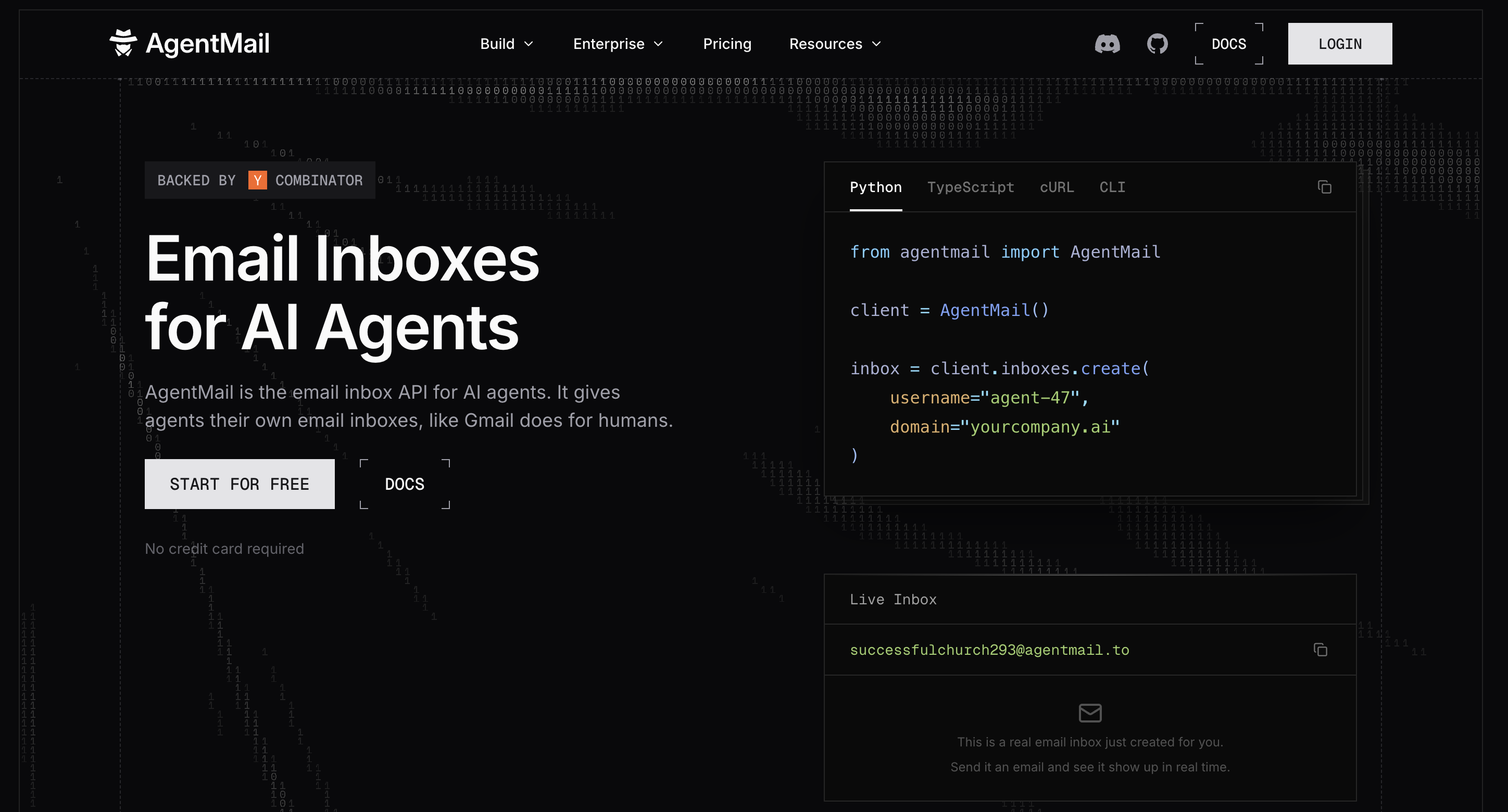
AgentMail. An Inbox provisions through client.inboxes.create() and acts as the agent's identity on the internet: a real address that people, services, and other agents can send to. Messages accumulate in Threads for long-term agent memory. Real-time inbound arrives over webhooks or WebSockets. Replies thread automatically through messages.reply. Tenants isolate through Pods with per-pod and per-inbox API key scoping, which we wrote up in multi-tenant email infrastructure for agents. Allowlists and blocklists filter senders per inbox. Drafts support human-in-the-loop approvals. Each inbox is also reachable over standard IMAP and SMTP, so ops teams and legacy mail clients can connect without going through the API. AgentMail integrates natively with Replit for agents built on that platform, and there are setup pages for Claude Code, Cursor and the rest of the coding agents we support. The Quickstart walks through the full send-and-receive loop. AgentMail is SOC 2 Type II.
Category 2: Transactional email APIs
Built for sending. Inbound exists on most of them as a webhook forwarder, with no inbox object, no persistent storage of conversations as a unit, and no programmatic provisioning of new addresses without DNS configuration.
Mailtrap. Transactional email API service for developers, with sending split across separate IP pools by default and SPF/DKIM/DMARC set up automatically, including monthly DKIM rotation. Inbound runs through the Agent Inbox app, which stores messages in hosted inboxes provisioned via the API, without automatic threading. An official MCP server and Agent Skills cover sending, logs, and templates from coding assistants like Claude Code and Cursor. No multi-tenancy beyond sub-accounts on the Business plan. Pricing: free for 4,000 emails/month, shared across send and receive; Basic from $15/month for 10,000; Business from $85/month with a dedicated IP. Best for: transactional sending with dedicated IPs, plus light inbound storage. See the full AgentMail vs Mailtrap comparison.
Resend. Modern transactional API from the team behind React Email. Inbound parsing arrived in November 2025 as a webhook with a 30-day retention ceiling. No inbox, no thread model, no per-agent provisioning. Pricing: Free for 3,000 emails, Pro from $20/month for 50,000, Scale from $90/month. Best for: clean send-side developer experience and React Email templates. See the full AgentMail vs Resend comparison.
SendGrid. Enterprise sender since 2009, owned by Twilio. Inbound Parse POSTs raw MIME to a webhook; if your endpoint returns 5XX, the message retries for up to three days and is then dropped without notification. No persistent inbox. Multi-tenancy uses subusers, available only on the Pro plan at $89.95/month. Free tier was replaced by a 60-day trial in 2025; paid plans start at $19.95/month. Best for: enterprise volume already in the Twilio ecosystem.
Postmark. Strong deliverability reputation since 2010, owned by ActiveCampaign. The inbound webhook is more capable than most transactional APIs. The payload includes the full body, headers, spam score, and Base64-encoded attachments. Still no inbox object. Inbound is locked to the Pro tier at $16.50/month or Platform at $18/month; the $15 Basic plan does not include it. Default retention is 45 days, extendable to 365 days on paid plans. Postmark also shipped open-source Skills for AI coding agents in February 2026. Best for: send-heavy workloads where deliverability is the top requirement.
Amazon SES. AWS-native sender since 2011, priced at $0.10 per 1,000 emails sent and another $0.10 per 1,000 received, plus $0.12 per GB of attachments. Receiving routes raw MIME to S3, SNS, or Lambda. There is no inbox object, no thread model, no persistent message store. The receive pipeline (Lambda parser, DynamoDB schema, IAM policies, S3 lifecycle) is the customer's project. Best for: AWS-deep teams sending at very high volume who are comfortable building the inbox layer themselves. See AgentMail vs Amazon SES.
The category's structural limit: most products here treat inbound as a webhook event, not as a conversational object. For an agent that needs to read, remember, and respond in-thread across time, that means building a database, a threading service, and a per-tenant routing layer on top of the webhook.
Category 3: Email integration APIs
Nylas Connected Accounts. A unified OAuth layer over Gmail, Microsoft 365, Exchange, Yahoo, iCloud, and IMAP. One API surface, one set of webhooks, six providers. The agent acts on a human user's existing mailbox. Pricing is per connected account: $15/month base on the Full Platform plan, plus $2 per additional account beyond the first five. Nylas added a beta product called Agent Accounts in 2026 that provisions a Nylas-hosted mailbox, with default limits of 100 sends per day, 1 GB storage, and 7-day retention. Best for: agents that need to read or send from a person's existing inbox across multiple providers, not provision their own. See AgentMail vs Nylas.
Category 4: Provider-native APIs
Gmail API. Google's REST surface for Gmail and Workspace. Free in raw API cost but priced operationally through Workspace seats ($7+ per user per month) and quota units (messages.send costs 100 of 6,000 per-user-per-minute on new projects as of May 1, 2026). Mailboxes are bound to a Google account; programmatic provisioning means creating Google accounts (with phone verification) or buying Workspace seats. Production use requires OAuth consent screen verification plus a restricted-scope security assessment recertified every 12 months. Gmail's abuse-detection systems can suspend accounts used for automation. Best for: agents acting on a single human user's existing Gmail inbox, or internal automation inside a Workspace tenant you control.
Category 5: Edge platform email
Cloudflare Email Service. Launched April 2026 as part of Agents Week. Outbound is a REST API and a Workers binding (env.EMAIL.send(...)) at $0.35 per 1,000 emails plus a $5/month Workers Paid plan minimum. Inbound routes through Email Routing into a Worker onEmail handler. There is no inbox object; building one means following Cloudflare's open-source Agentic Inbox reference app on top of Durable Objects, SQLite, and R2. Requires your sending domain to use Cloudflare DNS. The TypeScript-only onEmail handler doesn't reach Python agents or agents outside the Workers runtime. Best for: agents already running on Cloudflare Workers that send notifications and want to keep one vendor.
Decision tree: which one for which agent shape
- The agent needs its own email identity, sends, receives, and replies over time. → AgentMail.
- The agent only sends notifications and never needs to read replies. → A transactional API (Mailtrap if you want separate sending streams with basic inbound storage). Postmark for deliverability, Resend for developer experience, Amazon SES for lowest per-email cost at high volume, SendGrid for the Twilio ecosystem.
- The agent reads and acts on a specific human user's existing Gmail or Outlook. → Nylas Connected Accounts.
- The agent runs only inside a Workspace tenant you control, on Gmail. → The Gmail API directly.
- The agent runs as a Cloudflare Worker and the workload is mostly outbound. → Cloudflare Email Service.
- The product provisions one inbox per customer at signup, multi-tenant SaaS. → AgentMail. See running thousands of agent inboxes.
- The agent uses email as long-term memory across many threads over weeks or months. → AgentMail.
Which email API is best for receiving and parsing replies?
Most email APIs were built to send. When an agent needs to receive, the infrastructure splits into three models, and the right one depends on how the agent uses the replies. We compared the receiving side on its own in the best inbound email APIs for AI agents.
Native inbox (AgentMail). Inbound mail lands in a persistent inbox object, automatically threaded by Message-ID, In-Reply-To, and References headers. The agent queries its inbox like a mailbox: list threads, read the latest reply, respond in-thread. No parsing, no reconstruction, no storage layer to build. Real-time delivery over webhooks or WebSockets. Messages persist indefinitely and remain searchable.
# Receive and reply in-thread with AgentMail
from agentmail import AgentMail

client = AgentMail(api_key="YOUR_API_KEY")

# List messages in an inbox
response = client.inboxes.messages.list(inbox_id="inbox_abc123")

for message in response.messages:
    # Messages are already threaded, reply in context
    client.inboxes.messages.reply(
        inbox_id="inbox_abc123",
        message_id=message.id,
        text="Thanks for your message. I have processed your request.",
    )
Webhook parsing (Mailtrap, Resend, SendGrid, Postmark, Cloudflare). Inbound arrives as a one-time POST to your endpoint. Resend sends metadata only (body requires a follow-up API call) with 30-day retention. SendGrid's Inbound Parse delivers raw MIME and retries for 3 days on failure before silently dropping the message. Postmark's webhook includes the full body, headers, and attachments as JSON, with 45-day default retention (365 on Pro/Platform). Cloudflare routes into a Worker's onEmail handler. In all cases, messages are push-only events. Automatic threading and per-agent routing are the developer's responsibility.
IMAP forwarding (Gmail API, Nylas). The agent reads from a human's existing mailbox via OAuth. Threading is handled by the provider (Gmail's thread model, Outlook's conversation ID). The limitation is operational: OAuth tokens expire, quota limits apply, and for Gmail, autonomous access patterns risk account suspension. Nylas abstracts the provider differences but the agent still borrows a human's address rather than owning one.
When each fits:
The agent needs its own address and holds conversations over days or weeks: native inbox.
The agent reacts to one-time inbound events (form submissions, bounce notifications, occasional replies) and does not need persistent history: webhook parsing.
The agent must act on a specific person's existing mailbox: IMAP/OAuth via Nylas or the Gmail API.
Why AgentMail is the right default for agent inboxes
Most AI agent workloads end up needing an inbox. The agent signs up for services and needs to receive verification codes. It reaches out to leads and needs to respond when they reply. It owns a support address that customers email into. It coordinates with other agents that send mail back. Across all of these patterns, the agent's email is not a one-way pipe. It is a conversational identity that persists across time.
The transactional APIs in category 2 are built around the opposite assumption. They are pipes. Their webhooks deliver inbound events once, with retention windows measured in days rather than the months an agent's conversation history actually spans. Their multi-tenancy primitives sit in your application code, not in the platform. Building an inbox layer on top of a transactional API is feasible but is a real engineering project: a database, a thread reconstruction service, per-tenant routing logic, and storage management. The result is an inbox you maintain yourself.
The integration APIs in category 3 solve a different problem entirely. They give your agent access to a person's existing inbox, which is the right answer when that is genuinely what you need. It is not the same as your agent having its own address.
Provider-native APIs in category 4 carry the abuse-detection risk that comes with putting automation on Google or Microsoft accounts. The OAuth verification and per-user-quota model that Gmail uses fits interactive applications more cleanly than autonomous agents.
Edge platform email in category 5 fits a narrow stack constraint and works well within it.
AgentMail sits in its own category because the inbox is the primitive. Provisioning is one API call. Storage is persistent. Threading is automatic. Multi-tenancy is built into the platform through Pods. Identity is per-inbox, on domains you own and verify yourself. The same surface includes WebSockets for low-latency inbound, IMAP and SMTP for legacy mail clients, Drafts for human-in-the-loop approvals, allowlists and blocklists per inbox for inbound filtering, and an official skill for AI coding assistants, which works over MCP too. Production scale is real: AISDR runs autonomous SDR agents at scale on AgentMail with roughly 500 inboxes in production and 7,000 emails per week, no human in the loop. For agents that need an email identity built around the inbox, that is the shape AgentMail provides.
Choosing your path
The eight other options in this comparison each solve a real problem. Transactional APIs send. Integration APIs unify human inboxes. Provider-native APIs sit inside one provider's surface. Edge platform email fits one stack. Pick whichever one matches the problem you are solving.
If the problem you are solving is giving an AI agent an email identity that sends, receives, threads, remembers, and isolates per customer, the answer is in its own category. Agents that send and answer their own mail is the shape most teams start with.
The Free plan provisions real inboxes with full sending and receiving. No credit card required.
AgentMail is the first email provider built for AI agents. Create an inbox in one API call, send and receive email, no OAuth and no domain verification. Free tier, no credit card required.