We've raised $6M to build the first email inboxes for AI agents.

AgentMail has raised a $6M seed round led by General Catalyst. Learn why we're building email inboxes for AI agents and what's next.
- agentmail
- seed round
- ai agents
- email infrastructure
- agent identity

As reported by TechCrunch, we've raised a $6M seed round led by General Catalyst, with participation from Y Combinator and angel investors including Paul Graham, Dharmesh Shah (CTO of HubSpot), Paul Copplestone (CEO of Supabase), Karim Atiyeh (CTO of Ramp) and Taro Fukuyama.
I wanted to take a moment to share how we got here, what we're building, and where we're headed.

Why email, why now
AI agents are evolving from chatbots into virtual employees. They're booking meetings, negotiating contracts, handling support tickets, and coordinating across teams, autonomously.
As these agents take on more responsibility, they need the same infrastructure humans rely on. As a human, there's one piece of infrastructure I (literally) can't go a day without: my email. It's our most fundamental source of context, communication, and more importantly, identity.
The whole web is built around it; you don't have to integrate with every service separately.
But traditional email providers were designed for human users. Developers building agents have been forced to hack around rate-limited inboxes and send-only APIs that were never meant for this use case. We built AgentMail to fix that.
What AgentMail does
AgentMail provides dedicated email inboxes for AI agents, in the same way Gmail does for humans.
One API call creates an inbox. Your agent gets a real email address with full two-way communication: sending, receiving, threading, replying, searching, and labeling. Built-in spam detection and security for optimized deliverability at high volume. No manual setup, no OAuth flows, no human in the loop.
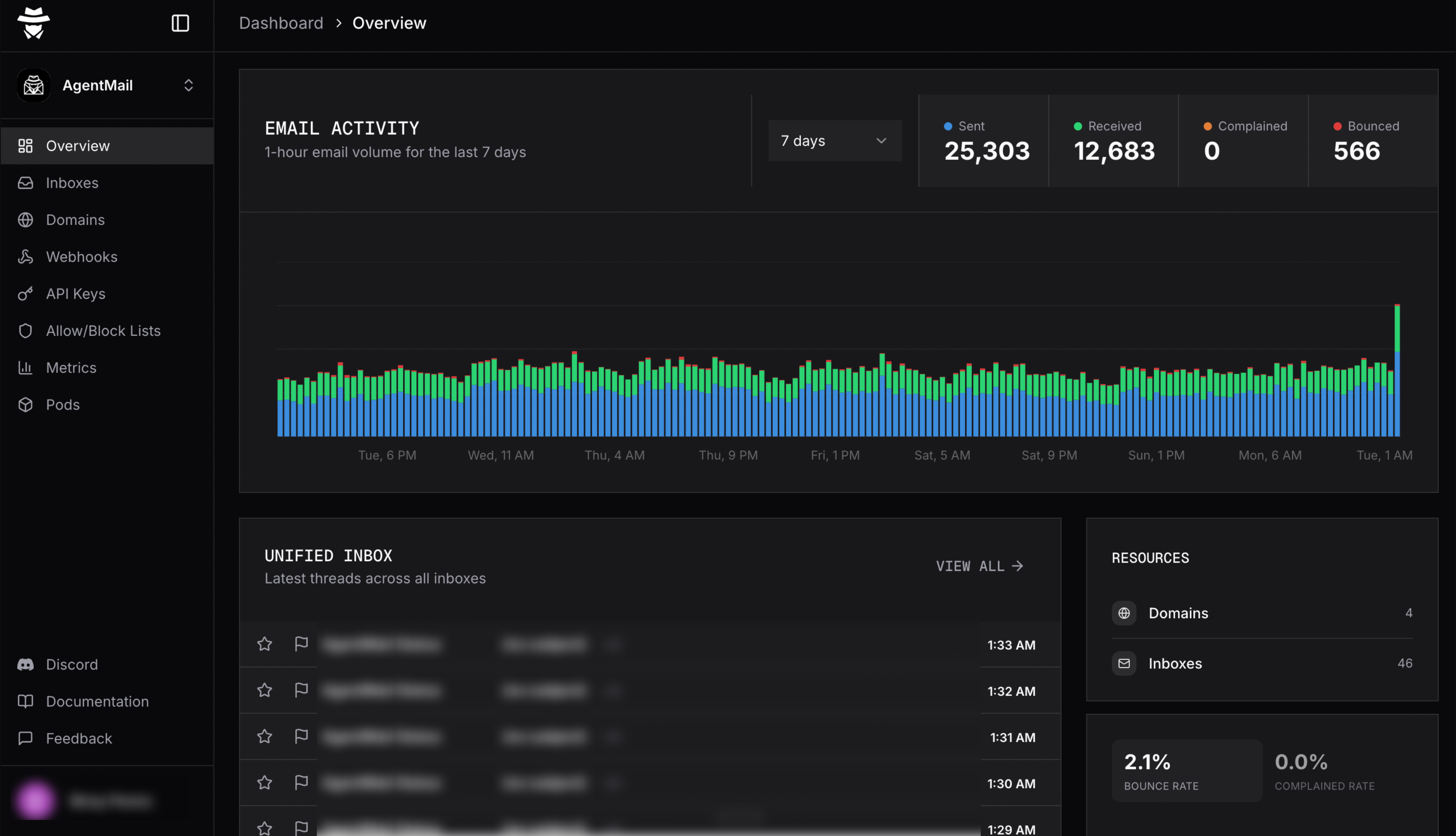
Unlike transactional email APIs that only send one-way notifications, AgentMail is built for agents that need to carry on real conversations. Agents can extract structured data from unstructured emails, and automatically label and categorize incoming messages. Webhooks and WebSockets deliver events in real time. It works out of the box with LangChain, LlamaIndex, CrewAI, and any framework that can make an API call.
What we're seeing
We've seen something we didn't expect. Autonomous agents have started signing up for AgentMail on their own, finding us through web search, navigating to our site, and creating their own inboxes without a developer in the loop. We always believed the next billion users of the internet will be AI agents. Turns out, they're already here.
The use cases keep growing and they're more diverse than you'd expect. Supply chain teams running agents that coordinate dozens of carriers, tracking loads and resolving exceptions over email in real time. Loan collection agents handling payment reminders and plan follow-ups. Support agents managing inboxes autonomously. Procurement bots negotiating with vendors over email. Thousands of humans use AgentMail to power millions of agents.
"AgentMail took email from the thing I worried about most to something I don't think about. Now thousands of DoAnything agents operate autonomously with their own email identities." Garrett Scott, CEO of DoAnything.com
Our investors
This round was led by General Catalyst, with participation from Y Combinator and Phosphor Capital.
"AI agents are already starting to function as virtual employees across industries. These agents need their own identity, and email is the heart of identity on the internet. Traditional identity services were not built with agentic use cases in mind, and AgentMail is building that part of the stack, starting with email. The team's clarity of vision and speed of execution stood out to us immediately." Yuri Sagalov, Partner at General Catalyst
Our angels include Dharmesh Shah (CTO of HubSpot), Paul Copplestone (CEO of Supabase), and Karim Atiyeh (CTO of Ramp).
What's next
Email is the starting point. As agents take on more of the work that humans used to do, they'll need real identity on the internet. Not just inboxes, but credentials, reputation, and trust.
We want every agent that wants to use the internet like us humans to have an AgentMail inbox. We're building the infrastructure so that any agent can sign up, get an identity, and start communicating with the real world.
A lot more is coming. If you're building AI agents that need to communicate with the real world, we'd love to hear from you.