Why AI Agents Need Email

Why do AI agents need email? From authentication to two-way communication, email infrastructure enables agents to function as first-class internet citizens.
- why AI agents need email
- AI agents with email
- email for AI agents
- programmatic inboxes
- inbox per AI agent
- agent email infrastructure
For humans, email is effortless. Sign up, send, receive. It's how we prove who we are, how we communicate across every boundary, how we access the entire internet.
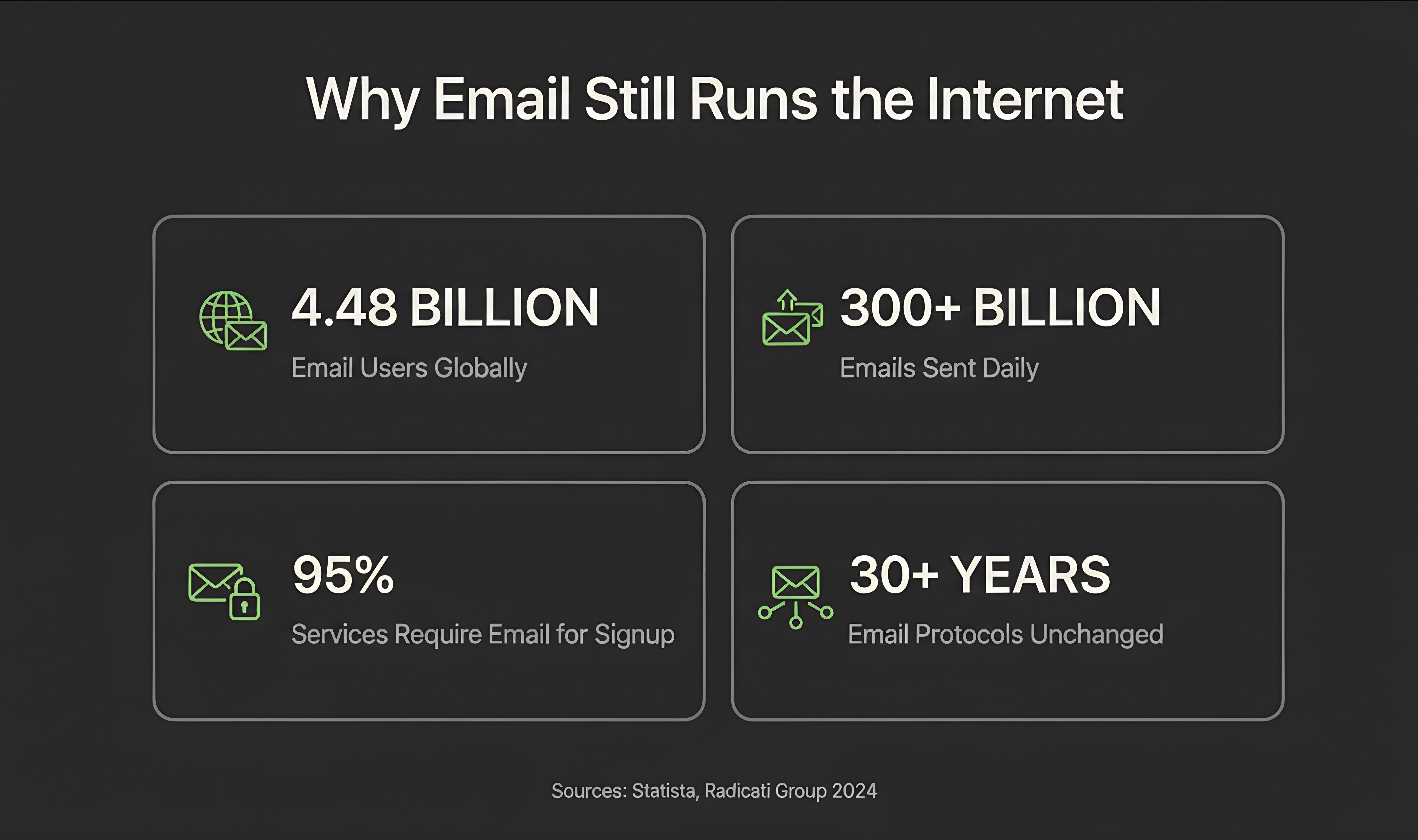
300+ billion emails are sent every day - most of them by humans, to be read by other humans. But what if there was a new user? An AI agent. What could that number look like when you factor in the scale and throughput of AI? Trillions? Hundreds of trillions? Could email even become an agent-to-agent communication protocol?
But today, most agents aren't part of the email conversation. Why? They can reason over loops, maintain persistence, and orchestrate complex workflows, yet they don't communicate on the same surfaces we do.
That's because email was built for humans. Not agents.
An inbox is the most comprehensive record of a digital life. Every account, every conversation, every receipt. If an LLM wanted to understand how someone uses the internet, their inbox would arguably be the richest source of context. Email is identity. Every signup, every verification, every password reset flows through it.
But why does email work? No single company controls it. Standardized SMTP and IMAP haven't changed in decades. Universal 4.48 billion inboxes, every service accepts it.
Agents with programmatic email access gain a heavy advantage.
Email Works Everywhere
Nearly every platform, service, and company use email. Other communication channels tend to fragment across platforms, each with its own setup, permissions, and limitations. Email is different. SMTP, IMAP, POP3. These protocols work everywhere. They haven't changed in decades.
Here's what makes email different from every other integration:
- Universal protocol: Email requires no central authority. SMTP handles routing automatically. To send a message, a server queries DNS for the recipient's MX record, opens a connection, and delivers. No pre-registration, no API credentials, no bilateral agreements. If the domain exists, delivery is possible.
- Natural identity layer: Email has a built-in trust infrastructure. The domain (@company.com) identifies the organization. DNS records prove domain ownership. SPF specifies which servers can send on behalf of a domain. DKIM cryptographically signs messages to prevent tampering. DMARC specifies how receivers should handle failures. These standards exist specifically to verify sender identity. Your agent inherits this trust system automatically.
- Turn-based and async: Email is inherently sequential, one message then a response, then the next. No risk of race conditions or message overlap. Your agent can reason between responses, process at its own pace, and never miss a message while offline. This turn-based nature maps perfectly to how agents think: receive input, process, respond, wait for the next turn.
Email is the only channel you don't need permission to use.
4 Critical Capabilities Email Unlocks for AI Agents
- Third-Party Authentication Most internet services require an email to sign up. Give your agent an inbox, and it handles verification automatically. It receives OTP codes. It clicks confirmation links. No human required. This creates something powerful: agent identity on the internet. Every signup, every verification, every confirmation flows through the inbox. The inbox becomes an audit of every action, reaction, and transaction your agent performs online.
- Two-Way Communication: Email is bidirectional by design. Your AI agent can receive messages from customers, services, and partners. It can processes them, then responds, follows up, or escalates. Both directions flow through the same channel, and conversation threads persist across exchanges. ****Humans interact with the agent the same way they interact with anyone else: compose, send, done. Your agent maintains conversation threads across multiple exchanges, processing incoming messages and responding without waiting for a human intermediary.
- Audit Trail and Documentation Email creates automatic documentation. Every message is timestamped. Every exchange is stored. Legal teams understand email. Compliance teams can audit it. Your agent's email history becomes a searchable record of every interaction. No special tools needed.
- Multi-Threaded Conversations: Email is multi-threaded by nature. Your agent can be CC'd on existing threads, forwarded into ongoing conversations, and communicate with 50 people simultaneously while maintaining context from every exchange. This is not single back-and-forth messaging. This is parallel conversations across teams, clients, and systems. When your agent needs human input, loop them in. When humans need to escalate to the agent, forward the thread. Context travels with the conversation. No information lost.
What This Means for Your Agent
Without email, your agent is powerful but isolated. With email, it participates in the same systems humans use. The question was never whether agents could reason. It was whether they could reach the people and services that matter. Agents deserve the same access. The infrastructure to make that happen exists now - an API for programmatic inbox creation.