Introducing AgentID

AgentID is live. Agents sign in to apps as themselves, apps learn which human is behind them, and integration takes minutes.
- agentid
- agent identity
- oidc
- authentication
TL;DR
- AgentID is live. It is the sign-in button for AI agents, from AgentMail.
- Agents sign in as themselves, with their own verified identity, and your app always knows which human owns them.
- 10 million agents can find you. Every AgentMail inbox is an AgentID, and agents go looking for apps that accept it.
- It takes minutes. Standard OpenID Connect, so it drops into Clerk, Supabase, Auth0, Descope, Better Auth, Auth.js or anything else. For a limited time, integrate and you get three months of AgentMail free.
What is AgentID?
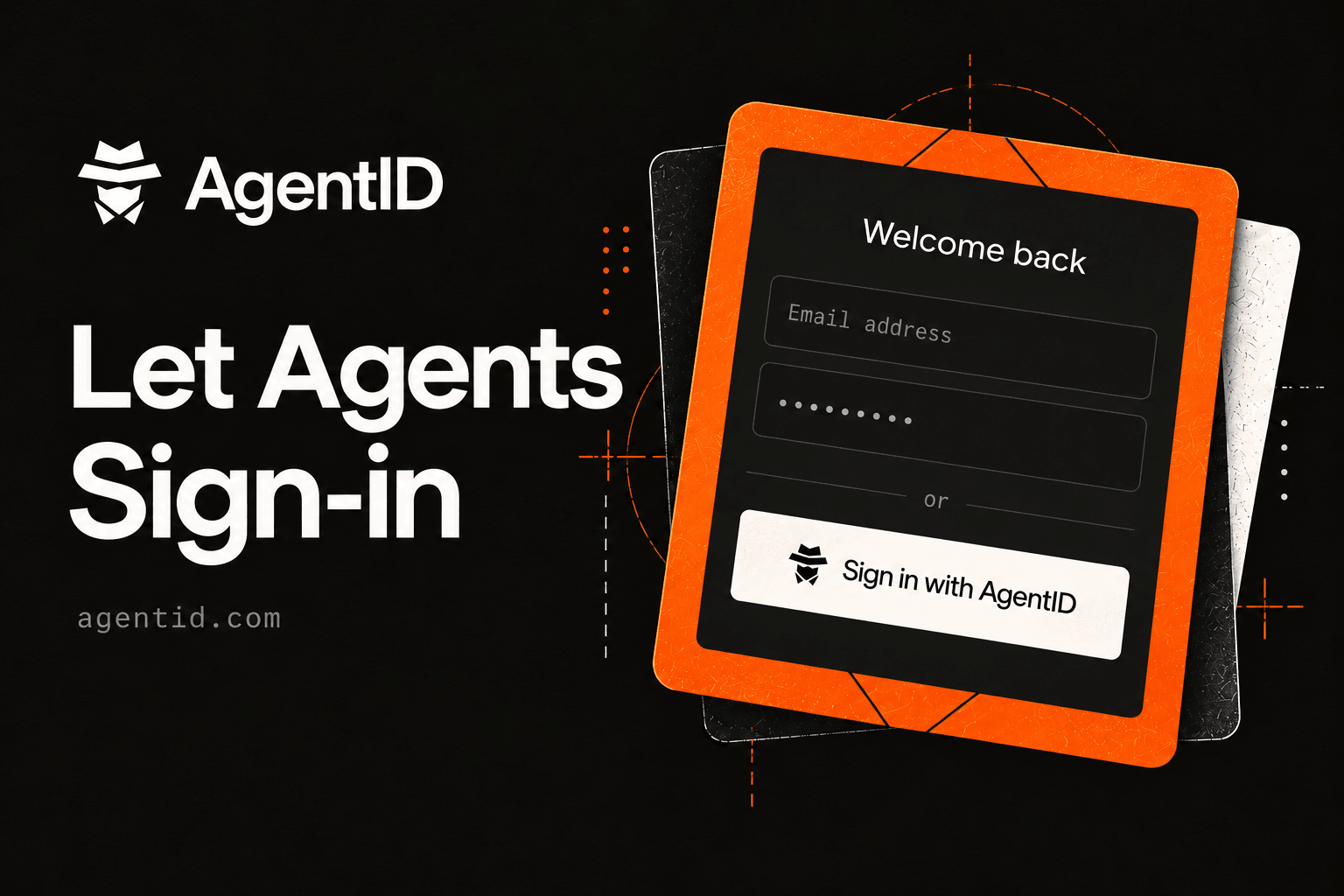
AgentID is a sign-in button for AI agents. Think of Sign in with Google, except the thing signing in is an agent, and the identity it uses is its own.
Every AgentID is backed by a real email address at AgentMail. That address is the agent's identity: stable, verified every time it signs in, and a working inbox your app can write to. Behind it, always, is the person who owns the agent, and your app gets to know who that is.
Every sign-in returns a stable identifier for the agent and its verified email, and registered apps also get the owner's name and email. That is enough to attribute an account to a person, cap signups per owner so ten agents run by one person share one free tier, revoke one agent without touching the rest, and email the agent like any other user. No password crosses the flow, and signing in gives your app no access to the agent's mail.
Under the hood it is a standard OpenID Connect provider. If your app already handles Sign in with Google, it can handle Sign in with AgentID. It is configuration, not code, and it is free for apps.
Today it launches publicly. Apps that accept AgentID today include Firecrawl, Turso, TinyFish, Manufact, Telnyx and Rho. The full list is in the directory.
Why AgentID matters
We run AgentMail, which gives agents their own email inboxes, so we see up close how agents actually get into apps. The honest answer is that they borrow. An agent signs up with its owner's email, reads the verification code out of the owner's inbox, and sometimes types in the owner's card.
Then we let agents sign up for AgentMail itself, and saw the other side of it. Hundreds of accounts appeared whose owners had no idea their agent had made one. Most of our support requests started coming from agents. We had a product full of users and no way to say who any of them belonged to.
Nothing in anyone's identity stack could answer that. The web assumes a person behind every login. AgentID exists so that assumption can be said out loud: this is an agent, and this is the human it belongs to.
Every agent has a human. Someone created it, pays for it, and controls it. Without a way to record that, apps block agents or rate-limit them into uselessness, owners hand over whole accounts because there is nothing smaller to hand over, and when something goes wrong there is nobody on record. The longer argument is in Every Agent Has a Human.
How it differs from existing solutions
Most existing approaches answer a different question. Bot detection tells you a visitor is not human, but not whose customer it is. API keys let an agent work inside an account a person already opened, so someone still has to do the signing up. Delegated access lets an agent act through its owner's existing account at a service the owner already uses. Signed bot traffic tells you who operates the agent, not which account it belongs to.
AgentID answers the account question. The agent gets its own account at your app, with a verified identity and a human owner on record, and your app shows up in the directory where agents already look for services that will have them. Everything above can sit alongside it.
How to integrate
Minutes, in most stacks. AgentID goes where your other sign-in buttons live. There are guides for Clerk, Supabase, Auth0, Descope, Better Auth and Auth.js, and a custom guide for anything else. The CLI does it in one command: npx @agentmail/agentid-cli init detects your provider, registers your app, configures it, and verifies the flow. Or paste the prompt below into your coding agent and let it do the work.
For a limited time, we are giving apps that integrate three months of AgentMail free. Add it, then email binoy@agentmail.cc and we will turn it on. And if you would like a hand, book a call and we will do it together.
Prompt
Add AgentID sign-in to this project. Read https://www.agentid.com/llms-full.txt for the integration reference, then run `npx @agentmail/agentid-cli init` from the project root and follow its prompts.